
Selecting Eco-Friendly Materials for Commercial Restroom Performance
Eco-friendly commercial restroom materials should be selected on more than recycled content alone. Recycled metals, HDPE, composite surfaces, reclaimed materials, and renewable products must balance environmental impact with durability, moisture resistance, cleanability, accessibility, fixture coordination, and lifecycle performance.
For architects, interior designers, MEP engineers, contractors, specifiers, and facility teams, the best material is the one that performs in the actual exposure zone, integrates with plumbing and mounting conditions, and can be documented for the project’s sustainability goals. For broader system-level planning, review commercial sustainable restroom design, water-efficiency, and energy-conservation strategies .

Quick Material Selection Guide for Commercial Restrooms
Use this summary as an early screening tool before reviewing the detailed material, durability, code, and lifecycle sections below. Final suitability depends on the specific manufacturer, assembly, finish, installation method, cleaning regime, and exposure conditions.
| Material | Best Application | Typical Moisture Performance | Typical Durability | Sustainability Focus |
|---|---|---|---|---|
| Recycled stainless steel | Fixtures + accessories | High | High | Recycled content + long service life |
| Recycled HDPE | Partitions + lockers | High | High | Post-consumer content + moisture stability |
| Recycled composites | Countertops + integrated basins | Medium–High | High | Recycled aggregates + reduced virgin content |
| Reclaimed wood | Feature walls + ceilings | Low | Medium | Material reuse + embodied-impact reduction |
| Bamboo / renewable panels | Dry walls + ceilings | Low–Medium | Medium | Renewable feedstock |
This guide is organized around primary technical references and project-use criteria, including ADA accessibility requirements, EPA WaterSense, ASME plumbing standards, ISO EPD/LCA frameworks, AIA guidance, USGBC resources, and CALGreen. Environmental claims should still be confirmed against the exact product submittal and applicable project code requirements.
Regulatory and Standards Context for Restroom Materials
Sustainable restroom specifications must preserve accessibility, plumbing performance, water efficiency, durability, installation tolerances, and service requirements while pursuing environmental objectives. Teams working toward broader certification goals can also review LEED and WELL requirements for commercial restroom fixtures .
Coordinate Environmental Goals with Code and Fixture Performance
Environmental attributes should supplement—not compromise—the technical requirements of the completed restroom. Material thickness, surface characteristics, mounting substrates, wet-area performance, plumbing penetrations, and accessory attachment conditions can all affect whether the finished installation performs as intended.
Standards should therefore be reviewed at the same time as the architectural finish schedule, plumbing fixture schedule, accessibility drawings, and product submittals.
Accessibility and Clearances (ADA)
Material selections must support and not undermine compliance with the 2010 ADA Standards for Accessible Design. Standards address clear floor space, reach ranges, lavatory heights, grab bar placement, turning radii, and floor surface characteristics.
The full text of the 2010 ADA Standards can be found at:
2010 ADA Standards for Accessible Design
The following are the most relevant ADA issues from a materials standpoint:
- Slip resistance and surface continuity at floors and transitions, especially at wet areas.
- Tolerances at finished surfaces affecting grab bar standoff, lavatory knee clearance, and flush control access.
- Wall construction and backing to support loads on grab bars and accessible fixtures even when finish materials are non-standard, such as reclaimed or composite panels.
Water Efficiency (EPA WaterSense and CALGreen)
Water-efficient fixtures and controls are often specified along with sustainable finishes. The EPA’s WaterSense program offers performance-based specifications and labels for high-efficiency toilets, urinals, faucets, and flushometer-valve toilets, among other devices.
CALGreen code adds both prescriptive and voluntary requirements for water use, recycled content, and construction waste management for nonresidential buildings in California. The following link provides an overview of CALGreen’s green building requirements:
CALGreen Green Building Requirements Overview
These frameworks tie percentage recycled content, construction waste diversion, and water use reductions directly to specification language and submittal requirements.
ASME A112.18.1/CSA B125.1 Plumbing Performance Standards
Eco-friendly material choices cannot diminish fixture performance nor affect code compliance. For plumbing supply fittings, such as faucets, showerheads, metering valves, etc., the principal North American standard is ASME A112.18.1/CSA B125.1, covering supply fittings and accessories between the stop and the terminal fitting.
Information about ASME A112.18.1 can be found at:
ASME A112.18.1 Plumbing Supply Fittings Standard
Designers should make sure any “green” material decisions at lavatory decks, mounting substrates and enclosures do not interfere with fittings conforming to ASME A112.18.1/CSA B125.1 and related codes.
Recycled Materials in Commercial Restrooms
Recycled-content materials can be included in partitions, countertops, wall cladding, tile, fittings, accessories, and architectural metals. The practical specification question is not recycled content alone, but how that content performs under moisture, cleaning, impact, mounting loads, and long-term commercial use. Related finish and fixture relationships can be reviewed in coordinate commercial bathroom faucets, fixtures, and countertops .
Evaluate Recycled Content Against Lifecycle Performance
Architects and specifiers should compare environmental documentation with alloy, gauge, panel thickness, structural support, moisture stability, cleaning compatibility, impact resistance, and replacement frequency.
A higher recycled-content percentage does not automatically produce a better commercial restroom material if the selected product requires frequent replacement or cannot withstand the actual cleaning and occupancy conditions.
Recycled Metals: Stainless Steel and Aluminum
Applications
- Flush valve covers, sensor faucet bodies, grab bars, recessed accessories, and panel systems.
- Architectural trim and corner guards in high-abuse areas.
Design and Specification Considerations
Many stainless steel products have significant pre- and postconsumer recycled content. When CALGreen or project sustainability goals require quantifiable recycled content, specify minimum percentages and require documentation in accordance with the methodology provided in CALGreen.
California Building Standards Commission — CALGreen
Alloy selection between 304 and 316, together with gauge and finish selection, is usually more important to lifecycle performance than small variations in percentage of recycled content.
Recycled Polymer and HDPE Partitions
Applications
Toilet and urinal partitions, lockers, benches, and sometimes wall cladding.
Key Attributes
Recycled-content HDPE is a common specification for partitions due to its graffiti resistance, impact resistance, and moisture stability.
Panels may contain post-consumer recycled plastics. Recycled content documentation is typically coordinated with the project green building submittals.
Technical Issues
- Deflection and rigidity: panel thickness and bracing must control deflection under load, particularly where grab bars are mounted.
- Fire/smoke ratings: verify that required classifications for occupancy are met.
- Cleaning compatibility: Confirm that polymer formulations withstand the facility’s disinfectants and cleaners.
Recycled-Content Solid Surfaces and Composite Countertops
Applications
Toilet decks, molded-in basins, and ledges for accessories.
Material Types
- Composite surfaces made from recycled glass, ceramic, or industrial by-products.
- Engineered stone products with recycled aggregates.
Design Considerations
- Structural support for heavier composite slabs.
- Jointing, coved backsplashes, and integral aprons in splash zones.
- Chemical and impact resistance test data aligned with realistic cleaning protocols.
- Finished thickness coordinated with ADA-compliant knee and toe clearances.
Recycled Content Tile, Concrete, and Cementitious Products
Applications
Flooring and wall tile; precast elements; sometimes exposed concrete.
Technical Priorities
- Slip resistance in wet conditions consistent with ADA life-safety needs.
- Use of supplementary cementitious materials and recycled aggregates to reduce cement content.
- Proper grout and joint design to support cleanability and moisture resistance.
Reclaimed Materials: Opportunities and Constraints
Reclaimed materials can provide embodied-carbon savings and distinctive architectural character, but wet and high-use restrooms require careful review of moisture resistance, hygiene, fire performance, anchorage, dimensional variability, and serviceability. Broader sustainable finish strategies are also discussed in modern commercial restroom material and finish coordination .
Keep Reclaimed Materials Out of the Wrong Risk Zone
Reclaimed wood, masonry, brick, and stone can work effectively where splash exposure and cleaning intensity are controlled. Their successful use depends heavily on substrate design, sealers, waterproofing, attachment systems, and the ability to maintain required fixture and accessory clearances.
Materials should be located according to environmental exposure rather than appearance alone.
Reclaimed Wood as Accent Material
Recommended Uses
- Ceiling slats, feature walls, soffits, and non-contact surfaces outside of direct splash zones.
- Staff or low-traffic restrooms with stable environmental control.
Constraints
- Moisture sensitivity in heavy splash zones.
- Fire performance requirements; flame spread and smoke development criteria may call for additional treatment.
- Durable, low-VOC finishes that protect indoor air quality while meeting the green building criteria.
Reclaimed Masonry, Brick, and Stone
Applications
- Feature walls or plinths away from direct fixture spray.
- Transition zones between the lobby and main restroom area.
Technical Issues
- Breathable, low-VOC sealers that still provide stain resistance.
- Maintenance of slip resistance where masonry is used on the floors.
- Anchorage and substrates allowing for dimensional variability while maintaining alignment for fixtures and accessories.
Integrating Reclaimed Surfaces with Fixtures and Grab Bars
When grab bars, dispensers, and fixtures mount to reclaimed walls:
- Provide constant support irrespective of uneven finish thickness.
- Use adjustable mounting hardware to maintain ADA-compliant offsets and clearances.
- Coordinate waterproofing membranes behind reclaimed claddings to prevent water intrusion at penetrations.
Renewable and Bio-Based Materials
Renewable materials can support embodied-carbon reduction and reduce dependence on fossil-derived content, but their use in commercial restrooms depends on moisture management, chemical resistance, substrate stability, attachment performance, and field history. Material decisions should therefore be evaluated within the larger commercial sustainable restroom material and design strategies .
Use Renewable Materials Where Environmental Exposure Can Be Controlled
Bamboo, linoleum, cork, bio-based composites, cellulose, and wood-fiber products can contribute to sustainability goals, but commercial restroom teams should distinguish dry architectural zones from direct splash areas and concealed assemblies with elevated moisture risk.
Product sustainability should be evaluated together with test data, adhesives, finish systems, dimensional stability, warranties, and intended maintenance conditions.
Rapidly Renewable Panels and Surfaces
Examples
- Bamboo veneer and laminated sheet goods.
- Linoleum and some cork systems.
Recommended Uses
Walls and ceilings outside primary wet zones:
- Equipped with lockers and staff facilities with stable humidity and good ventilation.
Technical Considerations
- Limits of moisture exposure to the product.
- Low-VOC adhesives and finishes compatible with green building and CALGreen-type IAQ objectives.
- Substrate flatness and movement control to avoid telegraphing and cracking.
Bio-based Composites and Resins
Emerging products use bio-based resins or fibers in panels, countertops, or partition systems.
Evaluation Criteria
- Third-party testing for abrasion, impact, stain, and chemical resistance under realistic cleaning regimens.
- Fastener pull-out values and edge stability at accessory locations.
- Field history and warranty terms appropriate to occupancy type and use intensity.
Renewable Insulation and Backing Materials
Renewable insulation—e.g., cellulose or wood fiber—can be appropriate for wall and ceiling assemblies adjacent to bathrooms where moisture management is well controlled. Designers should generally favor moisture-stable insulation within bathroom cavities; any bio-based insulation requires a carefully coordinated vapor and water management strategy.
Materials That May Require Extra Caution in Commercial Restrooms
Not every environmentally preferred material is suitable for every restroom zone. Architects and contractors should flag materials whose moisture, chemical, fire, mounting, or documentation limitations could create premature failure or coordination conflicts.
Durability, Cleanability, and Infection Control
Green material performance is only meaningful when the material survives actual commercial occupancy, disinfectants, humidity, impact, and maintenance cycles. Specification teams should therefore consider lifecycle durability alongside initial recycled or renewable content, especially in high-traffic facilities where replacement frequency can quickly undermine sustainability objectives.
Specify for the Cleaning Regime the Facility Will Actually Use
Commercial restroom surfaces may be exposed to concentrated cleaners, disinfectants, standing moisture, repeated wiping, abrasion, impact, and vandalism. Test reports and maintenance instructions should match the intended facility environment rather than residential assumptions.
Detailing is equally important: joints, ledges, cutouts, exposed panel edges, sealants, bases, and backsplashes influence cleanability and moisture accumulation.
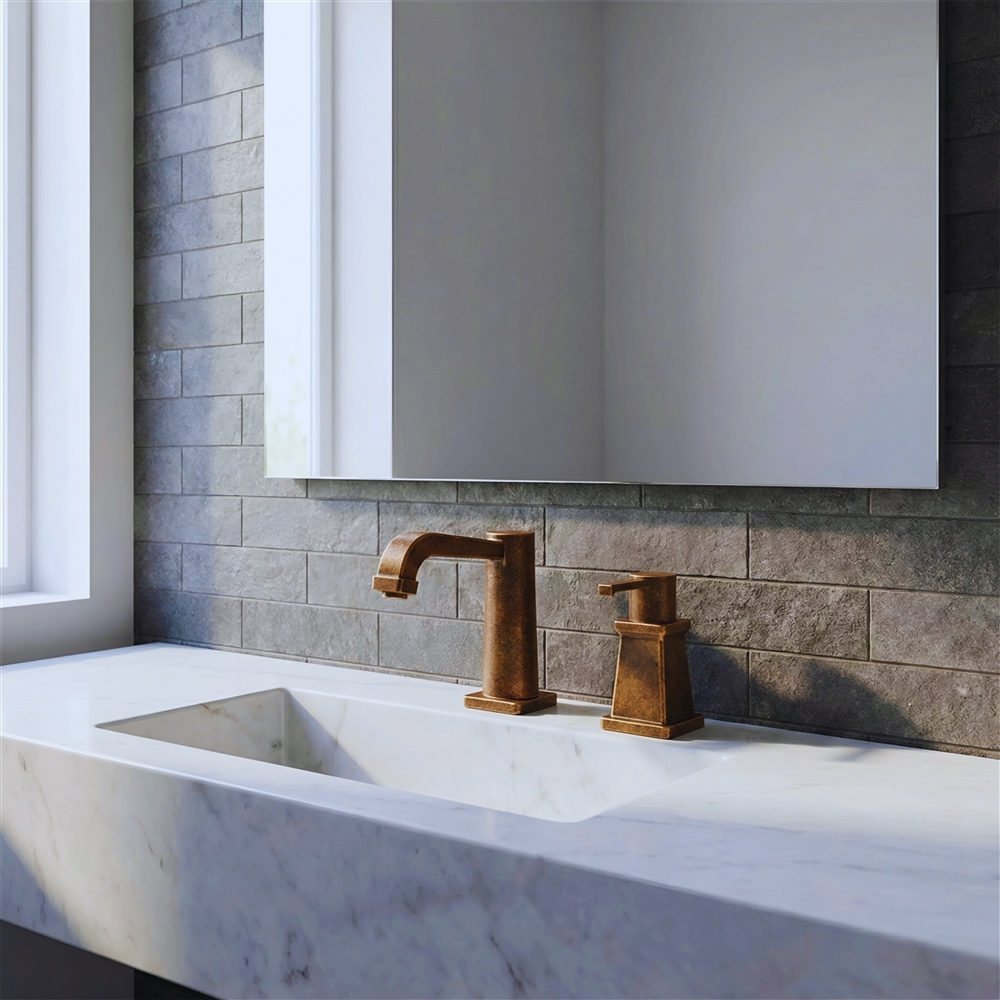
For commercial restrooms, sustainable material selection is only practical when materials can withstand:
- High occupancy and abuse.
- Intensive cleaning regimes.
- Cycles of humidity, and possible leaks.
Performance Metrics to Request
For major surface materials—partitions, counters, wall panels, and flooring—consider requiring:
- Abrasion/wear resistance: Testing shall be standardized, for example Taber abrasion or equivalent.
- Impact- and vandal-resistance with documented test data.
- Resistance to stain and chemical exposure to common disinfectants and cleansers.
- Colorfastness and UV stability in the presence of sunlight or high illuminance.
Hygienic Detailing
Detailing often has as much impact as material selection:
- Minimize horizontal ledges and unsealed joints that collect moisture and dirt.
- Use coved bases and integral backsplashes in high-splash areas.
- Coordinate fixture and dispenser cutouts to avoid exposed edges in composite or wood-based panels.
System Integration: Fixtures, Controls, and Building Systems
Sustainable finish systems must be coordinated between architecture Divisions 04/06/09/10 and plumbing Division 22. Material density, thickness, penetrations, blocking, waterproofing, sensor fixtures, controls, and maintenance access all interact. Related systems thinking is discussed further in automatic restroom fixture systems in sustainable commercial buildings .
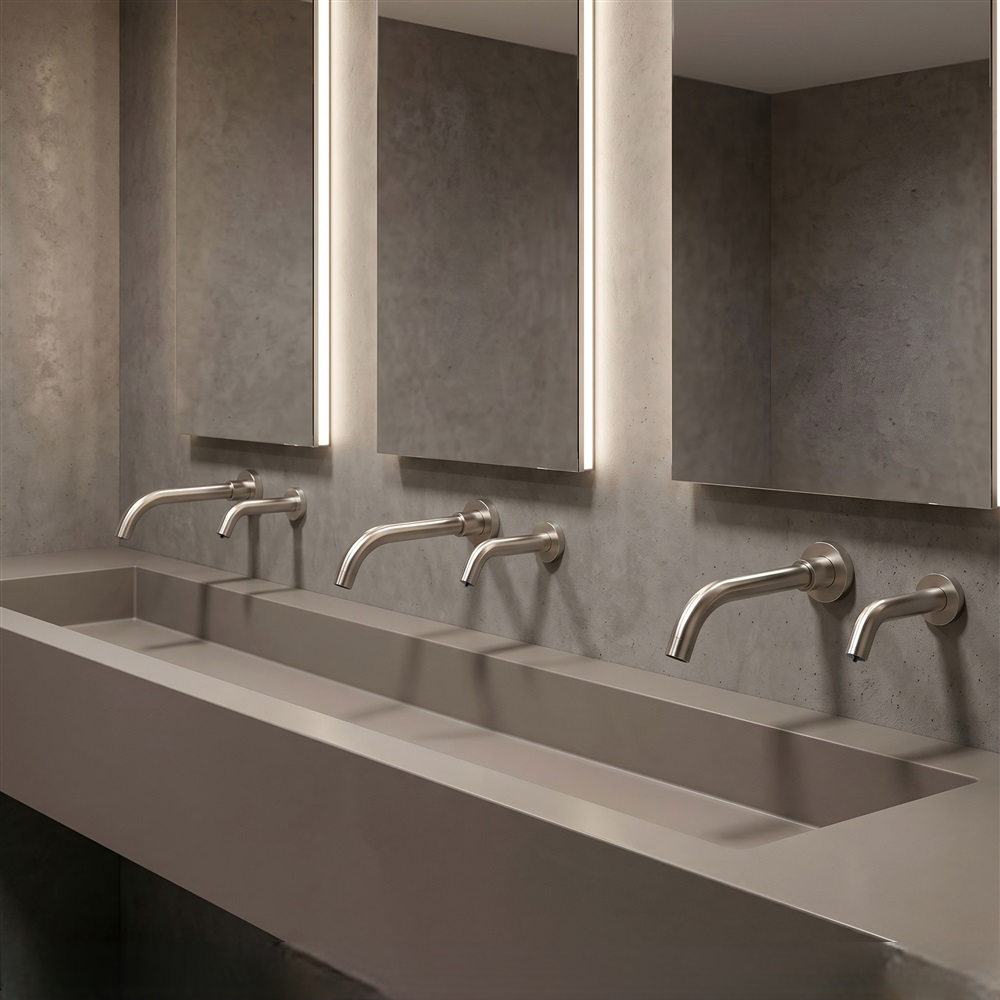
Coordinate Sustainable Finishes Before Rough-In and Blocking Are Closed
Alternative panels, reclaimed veneers, composite surfaces, thick slabs, and unconventional backing systems can alter fixture projection, attachment depth, accessibility clearances, waterproofing details, and service access.
Architectural and MEP teams should resolve these interfaces before walls, backing, and countertops are fabricated.
Substrates and Blocking for Sustainable Finishes
Eco-friendly finish layers often differ from conventional tile-on-stud assemblies in terms of density, thickness, and means of attachment.
- Continuous blocking must be provided for grab bars, wall-hung fixtures and heavy accessories before the installation of panelized claddings or reclaimed veneers.
- Check that fasteners recommended by the fixture manufacturers are compatible with the selected substrate; for example, metal framing with cement board versus composite panel systems.
Moisture and Vapor Control
Integrate the waterproofing membranes, backer boards, and sealants so that the sustainable finish materials are not solely serving as a barrier to water.
Special consideration should be given to the penetrations of sensor faucets, soap dispensers, flush valves and carriers; the gaskets and escutcheons must seat properly against the selected finish.
Water and Energy Data for Continuous Improvement
Metering and building automation complement WaterSense and local codes. The EPA WaterSense guidance for commercial buildings is available at:
EPA WaterSense: Commercial Buildings Guidance
Material durability must be measured by the feedback of the facility over time; repeatedly failing surfaces, or those that have to be replaced too often, will weaken sustainability objectives despite high initial recycled or renewable content.
Specification Strategies for Recycled, Reclaimed, and Renewable Materials
Performance-based material specifications give architects and engineers a clearer way to translate sustainability objectives into measurable requirements. Environmental claims should be supported by documentation, testing, installation criteria, and coordination across trades rather than used as a substitute for technical performance.
Connect Sustainability Documentation to the Actual Submittal
Recycled-content declarations, EPDs, LCAs, WaterSense documentation, material test reports, mounting details, rough-in drawings, adhesives, sealers, and maintenance instructions should be reviewed as parts of the same specification package.
This prevents sustainability criteria from becoming disconnected from constructability and installed performance.
Performance-Based Material Criteria
Specify performance outcomes and documentation wherever possible, rather than prescriptive brand names. Examples are:
- Minimum post-consumer and/or post-industrial recycled content percentages for partitions, tile, or metal components.
- Requirements that plumbing supply fittings comply with ASME A112.18.1 / CSA B125.1 and, where applicable, carry EPA WaterSense labeling for water efficiency.
EPA WaterSense Specifications & Certifications
Submittals shall include EPDs or equivalent LCA documentation if Embodied Carbon is a project driver.
Coordinating Divisions and Trades
To avoid gaps between “green” finishes and conventional systems:
- Align Division 09 Finishes and Division 10 Specialties requirements with Division 22 Plumbing and Division 07 Thermal and Moisture Protection.
- Ensure that specifications for partitions, countertops and wall panels explicitly coordinate with manufacturers’ mounting and rough-in diagrams for the installed fixtures.
- Where reclaimed or unconventional materials are used, require mockups that include fixtures, accessories, and representative penetrations.
Construction Waste and Deconstruction
Green building frameworks often address construction and demolition waste, which directly impacts how materials will be packaged, installed and ultimately removed. Guidance on managing construction waste related to CALGreen can be found at:
CALGreen Construction Waste Management Guidance
Strategies include:
Demountable or modular assemblies to facilitate future reuse or recycling. Coordinating with the Construction Waste Management Plan to ensure selected materials are able to enter available recycling streams.

Sustainability documentation should be reviewed alongside fixture rough-ins, mounting requirements, waterproofing, accessibility dimensions, cleaning protocols, and replacement access before materials are approved for construction.
Environmental Product Declarations (EPDs) for Commercial Restroom Material Specification
Environmental Product Declarations give architects, engineers, specifiers, contractors, and sustainability teams a standardized way to review documented environmental impacts associated with products and materials. An EPD is informed by Life Cycle Assessment (LCA) data and can support more transparent evaluation of commercial restroom materials, fixtures, surfaces, partitions, accessories, and related building products.
For design teams evaluating sustainable restroom assemblies, EPD information should be reviewed alongside durability, moisture resistance, accessibility, plumbing compatibility, maintenance requirements, service life, and the broader LEED and WELL commercial restroom specification strategy .
What Is an Environmental Product Declaration (EPD)?
An Environmental Product Declaration is a standardized environmental disclosure that communicates information about the potential environmental impacts and environmental aspects of a product. EPD development uses Life Cycle Assessment methodology, allowing environmental information to be organized around defined product, system-boundary, and lifecycle assumptions.
For architects and specifiers, an EPD can provide a more structured basis for reviewing environmental information than unsupported claims such as “green,” “eco-friendly,” or “sustainable.”
The current international framework is ISO 14025:2026 — Environmental Product Declarations , which specifies principles and requirements for EPD programs and identifies the use of ISO 14040 and ISO 14044 Life Cycle Assessment methodology in EPD development.
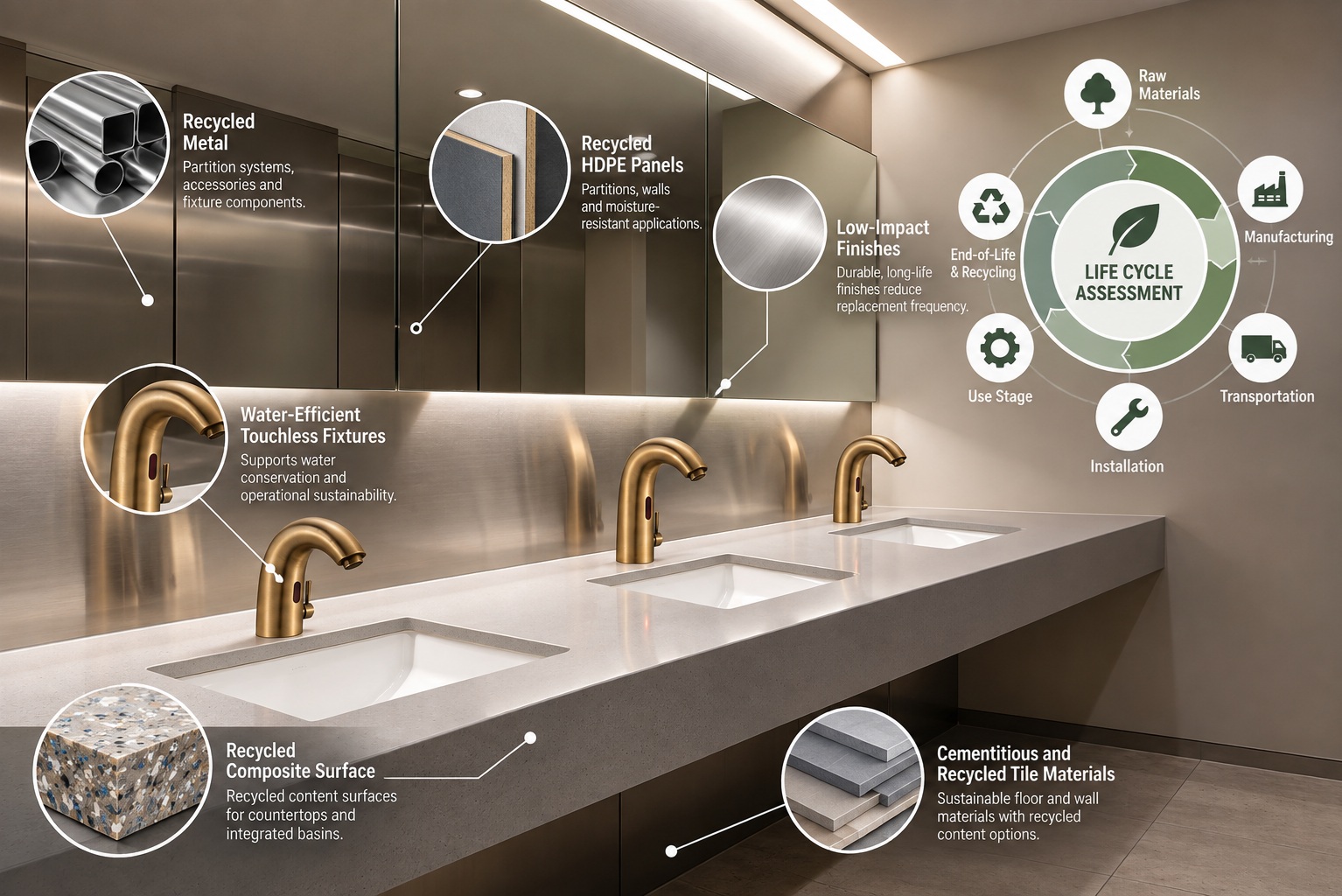
EPD vs. LCA: What Is the Difference?
A Life Cycle Assessment is the analytical process used to evaluate potential environmental impacts associated with a product across defined lifecycle stages. An EPD communicates environmental information derived from LCA within a standardized declaration framework.
In practical specification work, the LCA provides the analytical foundation, while the EPD provides a structured document that design and sustainability teams can review during product evaluation and submittal coordination.
Architects can review additional professional guidance from the American Institute of Architects — Environmental Product Declaration .
Does an EPD Mean a Product Is Sustainable?
No. An EPD is primarily a transparency and environmental-information tool; its existence alone should not be interpreted as proof that a product is environmentally preferable.
An EPD may document environmental impacts associated with a product, but architects still need to evaluate whether the product is appropriate for the project, performs its intended function, satisfies applicable requirements, and compares appropriately with alternatives.
This distinction is particularly important when reviewing commercial restroom products, where service life, water exposure, cleaning chemistry, replacement frequency, fixture compatibility, and maintenance can materially influence lifecycle decisions.


What Should Architects Review in an EPD?
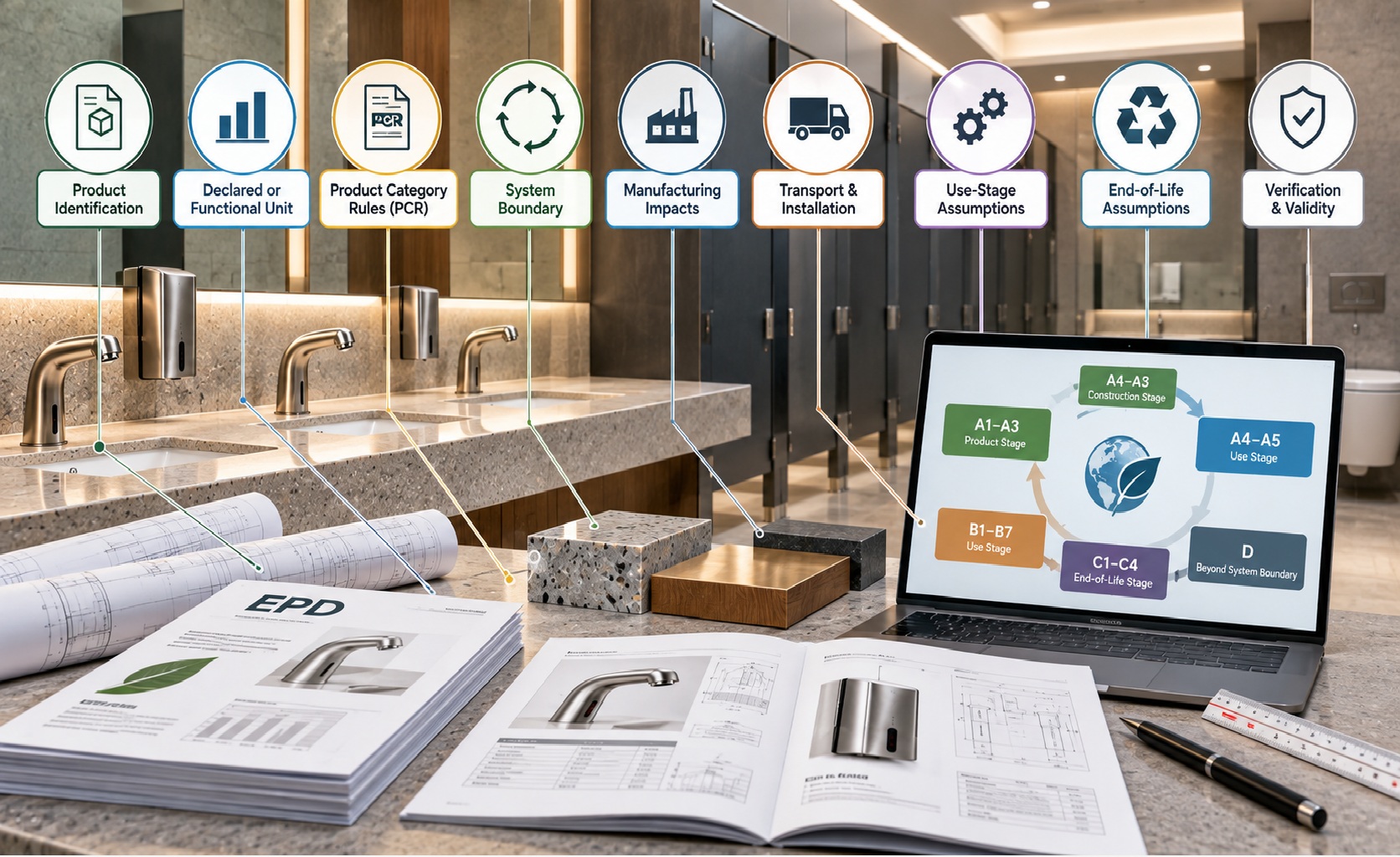
EPDs can contain substantial environmental data, but meaningful specification review requires more than locating an EPD logo or document in a manufacturer’s submittal package. The declaration scope and underlying assumptions should be understood before environmental results are used for comparison.
- Product identification: confirm that the declaration applies to the exact product, product group, or material being specified.
- Declared or functional unit: understand the reference quantity used to report environmental impacts.
- Product Category Rules (PCR): identify the rules governing how the applicable product category was assessed and reported.
- System boundary: determine which lifecycle stages are included in the assessment.
- Manufacturing impacts: review documented material, energy, production, and related environmental information within the declared scope.
- Transport and installation: determine whether relevant transportation, construction, or installation stages are included.
- Use-stage assumptions: identify applicable service-life, maintenance, replacement, energy, water, or operational assumptions where reported.
- End-of-life assumptions: review disposal, recovery, recycling, reuse, or other end-of-life scenarios included in the declaration.
- Verification and validity: review the stated verification, program information, issue date, and validity period provided by the declaration.
Two products should not be treated as environmentally equivalent—or directly comparable—simply because both have EPDs. Before comparing reported impacts, review whether the declarations address equivalent functions, compatible lifecycle boundaries, appropriate Product Category Rules, comparable reference units, and relevant environmental indicators.
How EPDs Support Commercial Restroom Product and Material Evaluation
In commercial restrooms, environmental documentation may be relevant to multiple architectural and building-system decisions rather than a single finish selection. Depending on the project and availability of verified documentation, design teams may encounter EPDs or lifecycle information for architectural surfaces, partitions, metals, countertops, plumbing-related products, accessories, and other building components.
The environmental documentation should therefore be coordinated with the physical assembly. For example, countertop selection affects basin and faucet installation; wall systems affect fixture and accessory anchorage; finish thickness can affect accessibility dimensions; and material durability can influence replacement frequency.
For these interface conditions, also review commercial faucet, fixture, basin, and countertop coordination .
Architect + Specifier EPD Review Checklist
Declaration Scope + Verification
- Does the EPD apply to the exact product or relevant product group?
- Is the applicable EPD program or declaration framework identified?
- Is third-party verification identified where applicable?
- Are the Product Category Rules (PCR) identified?
- Is the declared or functional unit clearly stated?
- Are the issue date and validity information current?
Lifecycle + Comparison Review
- Which lifecycle stages are included in the system boundary?
- Are raw-material and manufacturing impacts reported within the declared scope?
- Are transport and installation stages included or excluded?
- Are use-stage assumptions relevant to the intended commercial application?
- Are end-of-life, recycling, recovery, or reuse scenarios documented?
- Are products being compared on an equivalent functional and methodological basis?
Architects and specification teams can verify EPD principles and lifecycle methodology through ISO 14025:2026 , review architect-focused EPD guidance from the American Institute of Architects , and review material-transparency and lifecycle considerations through the U.S. Green Building Council .
Understanding EPD Lifecycle Stages for Commercial Restroom Products
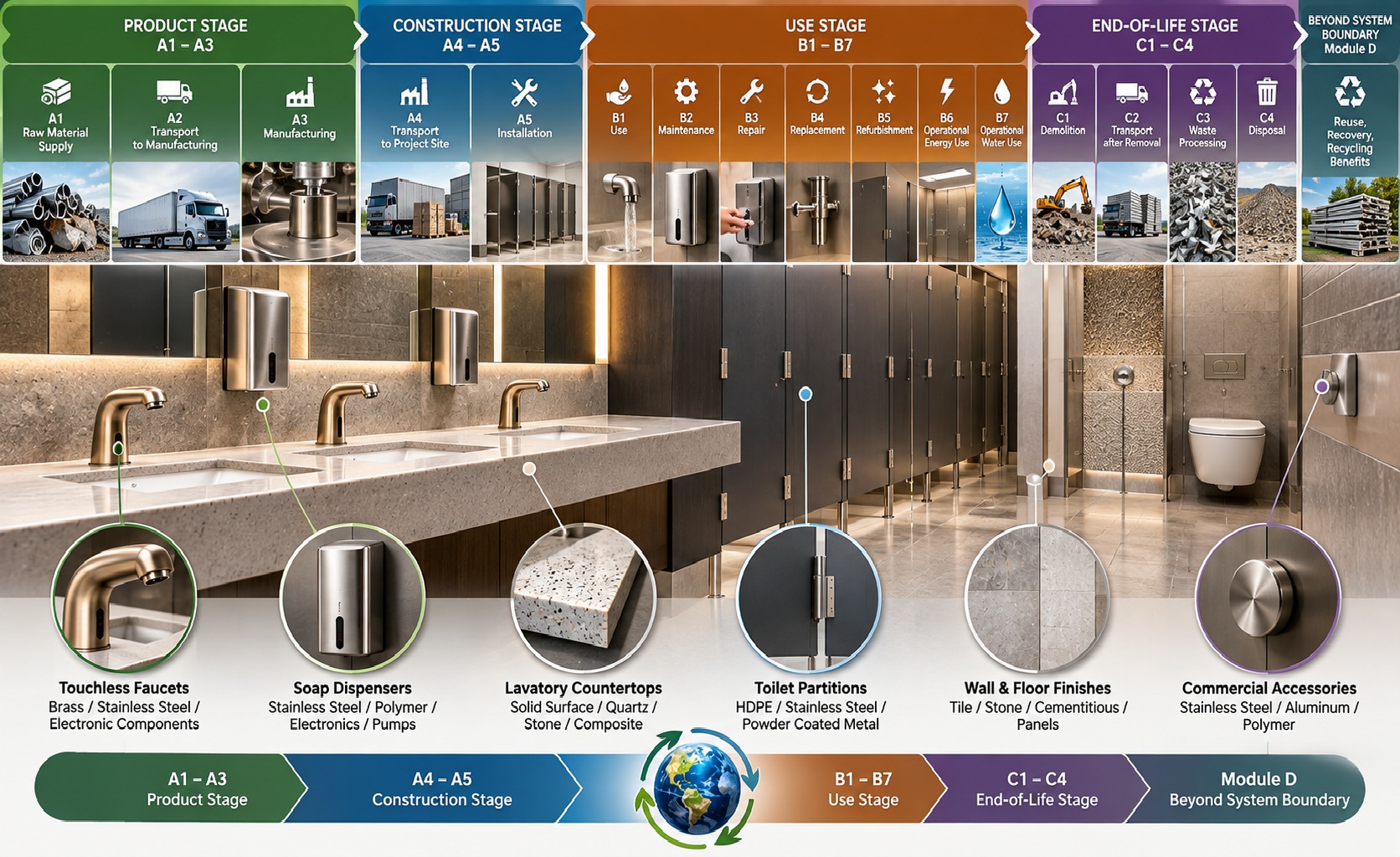
Lifecycle-module coverage matters when comparing EPDs. ISO 21930 organizes construction-product information into product, construction, use, end-of-life, and beyond-system-boundary modules. Architects should confirm which modules are included before comparing headline impact values. ISO 21930:2017.
A1–A3 = product stage; A4–A5 = transport and installation; B1–B7 = use stage; C1–C4 = end-of-life; Module D = potential benefits or loads beyond the system boundary when reported.
Product Stage
Raw-material supply, transport to manufacturing, and manufacturing. This is commonly described as cradle-to-gate coverage.
Construction Stage
Transport to the project and installation. Product weight, packaging, adhesives, sealants, mounting systems, and installation waste can affect this stage.
Use Stage
Use, maintenance, repair, replacement, refurbishment, operational energy, and operational water where applicable and reported.
End of Life + Beyond
Deconstruction, transport, waste processing, disposal, and—when reported—potential reuse, recovery, or recycling benefits beyond the system boundary.
Not necessarily. Compare products only when functions, reference units, Product Category Rules, lifecycle modules, scenarios, and assessment assumptions are sufficiently aligned. A1–A3 values alone do not describe the same scope as a broader cradle-to-grave declaration.
Practical Decision Framework for Design Teams
The practical approach is to divide the restroom into risk zones and then match material strategies accordingly. Fixture exposure, splash, cleaning intensity, user traffic, vandalism risk, and replacement access should influence where recycled, reclaimed, and renewable materials are used.
Spatial zoning can also be coordinated with commercial restroom layout, circulation, traffic flow, and privacy planning so material risk zones align with actual user movement and fixture locations.
How to Select a Sustainable Commercial Restroom Material
Classify the location as wet, moderate-exposure, or dry before considering environmental attributes.
Match impact, vandal, traffic, and cleaning intensity to the expected facility use.
Check stain, disinfectant, abrasion, and chemical-resistance data against the real maintenance program.
Coordinate finish thickness, clearances, backing, penetrations, attachment depth, and service access.
Review recycled-content declarations, EPDs, LCAs, certifications, test data, and product-specific submittals.
Consider service life, maintenance, replacement frequency, operational impacts, and end-of-life assumptions.
Resolve interfaces across architectural finishes, specialties, waterproofing, plumbing, controls, and construction sequencing.
Immediately surrounding fixtures, in front of urinals and inside stalls.
Specify nonporous, high-durability materials with demonstrated performance despite modest recycled content and continue to seek opportunities in backing, grout, and accessory metals.
Transition areas, circulation paths.
Specify durable recycled-content materials such as HDPE partitions, composite panels or tile with recycled aggregates.
Entries, ceilings, remote walls.
Introduce reclaimed or renewable materials at locations where moisture and cleaning intensity are lower, and detailing has more control over risk: reclaimed wood, bamboo, bio-based panels.
Pilot emerging eco-friendly materials where maintenance staff can provide early feedback before broader deployment.
Conclusion
Green commercial restroom materials—recycled, reclaimed, and renewable—must be considered along the same technical parameters as any high-performance building: code compliance, accessibility, durability, cleanability, and long-term maintainability. By anchoring material selection in recognized standards, such as ADA, EPA WaterSense, CALGreen, and ASME A112.18.1/CSA B125.1, requiring rigorous test data, and through careful coordination across architecture and engineering disciplines, design teams can minimize embodied and operational impacts without sacrificing function, hygiene, or user safety in commercial and institutional restroom environments.
| Material Type | Typical Use | Typical Durability* | Typical Moisture Performance* | Best Zones |
|---|---|---|---|---|
| Recycled metals (SS, Al) | Faucets, grab bars, accessories | High | High | High-abuse, high-splash areas |
| Recycled HDPE | Partitions, lockers | Medium–High | High | Stalls, heavy-cleaning zones |
| Recycled composites / solid surface | Lav decks, integrated basins | Medium–High | Medium–High | Lavatory counters, splash zones |
| Recycled tile / cementitious | Floors and walls | Medium–High | Medium–High | Floors, wet walls behind fixtures |
| Reclaimed wood | Feature walls, ceilings (dry) | Medium | Low | Low-exposure, decorative areas |
| Renewable panels (bamboo, etc.) | Wall/ceiling panels (dry) | Medium | Low–Medium | Dry walls/ceilings, staff areas |
*Typical performance descriptions are screening guidance only. Actual performance varies by manufacturer, assembly, finish, installation method, maintenance program, and exposure conditions.
Frequently Asked Questions for Architects and Specifiers
These specification questions address how architects, engineers, contractors, and facility teams can evaluate recycled, reclaimed, and renewable restroom materials while coordinating accessibility, moisture exposure, fixture interfaces, durability, documentation, and long-term maintenance.
How should sustainable restroom materials be evaluated before specification?
Sustainable materials should be evaluated against the actual operating conditions of the restroom, including moisture exposure, cleaning chemistry, impact resistance, substrate requirements, fixture penetrations, accessibility clearances, maintenance access, and expected service life. Environmental attributes should supplement—not replace—technical performance criteria.
For projects pursuing broader sustainability objectives, review LEED and WELL requirements for commercial restroom fixtures .
Can recycled materials be specified in high-traffic commercial restrooms?
Yes, when the selected material satisfies the required performance criteria for its location. Recycled-content stainless steel, aluminum, HDPE, composite surfaces, tile, and cementitious products can serve different restroom applications, but recycled content alone does not establish suitability.
Design teams should verify durability, moisture resistance, cleaning compatibility, structural support, fire requirements where applicable, and manufacturer documentation. California projects can also reference CALGreen nonresidential code and guides .
Where are reclaimed materials most appropriate in commercial restrooms?
Reclaimed wood, masonry, brick, and stone are generally better suited to controlled or lower-exposure locations such as feature walls, ceilings, entrance transitions, and surfaces away from direct fixture splash.
The specification should address moisture protection, sealers, fire performance, substrate variation, anchorage, cleaning requirements, and fixture interfaces. Material placement should therefore follow environmental exposure rather than appearance alone.
How do sustainable materials affect ADA coordination?
Finish thickness, floor transitions, wall construction, countertop dimensions, and mounting substrates can affect accessible clearances and fixture relationships. Sustainable material substitutions should therefore be checked against the completed assembly rather than reviewed as finish selections in isolation.
Architects and specifiers should coordinate the finished condition with the 2010 ADA Standards for Accessible Design .
Should sustainable countertop materials be coordinated with faucets and plumbing fixtures?
Yes. Countertop thickness, basin geometry, mounting holes, faucet projection, sensor location, soap-dispenser penetrations, structural support, backsplash conditions, and accessible knee and toe clearances should be coordinated before fabrication.
See the related technical guidance on coordinating faucets, fixtures, and countertops .
Do sustainable materials change plumbing fixture compliance requirements?
No. Environmental material objectives should not interfere with the required performance of plumbing fittings or their installation. Deck materials, wall panels, mounting substrates, penetrations, and finish thicknesses must remain compatible with the specified plumbing system.
For plumbing supply fittings, design teams can reference ASME A112.18.1/CSA B125.1 and applicable project plumbing codes.
How should water efficiency be coordinated with sustainable material selection?
Material sustainability and operational water efficiency should be treated as complementary specification objectives. Finish systems must accommodate the mounting, service access, penetrations, and installation requirements of water-efficient fixtures without compromising waterproofing or maintainability.
Project teams can reference EPA WaterSense specifications and certifications when evaluating applicable water-efficient fixtures.
What documentation should architects request for sustainable restroom materials?
Submittals should document the environmental attributes being specified together with the technical information required to evaluate installed performance. Depending on the material and project objectives, this may include recycled-content declarations, EPDs, LCAs, test reports, installation instructions, adhesives, sealers, mounting requirements, cleaning guidance, and warranty information.
Documentation should be reviewed alongside fixture rough-ins, waterproofing, accessibility dimensions, mounting details, and maintenance requirements rather than as a separate sustainability exercise.
How should architects select materials for different restroom risk zones?
Material selection should reflect exposure. High-splash and high-abuse locations generally require nonporous and highly durable surfaces; moderate-exposure areas can accommodate durable recycled-content products; lower-exposure architectural zones provide greater opportunities for reclaimed and renewable materials.
Risk-zone decisions should also be coordinated with restroom layout, traffic flow, and fixture placement so the material strategy reflects actual use conditions.
Environmental claims should be verified through project-appropriate documentation, while final material approval should also consider accessibility, plumbing interfaces, moisture management, cleaning protocols, installation requirements, service access, and expected commercial lifecycle.
Related Technical Planning Resources
Continue Technical Planning Beyond Material Selection
Continue sustainable restroom planning with related technical guidance for architects, engineers, specifiers, contractors, interior designers, and facility teams reviewing water efficiency, certification, material integration, accessibility, layout, and long-term building performance.
Use the resources below to move from material selection into water and energy performance, LEED and WELL coordination, architectural sustainability, and restroom layout planning.
Explore Sustainable Commercial Restroom Specification Resources
For project teams ready to move from material planning into coordinated specification, continue with commercial restroom water and energy performance, fixture and countertop coordination, LEED/WELL planning, and layout guidance.
Primary Technical References
These primary sources support accessibility, water efficiency, plumbing performance, environmental-product documentation, lifecycle assessment, green-building coordination, and California green-building requirements discussed throughout this guide.