
Commercial and institutional restrooms must balance spatial efficiency with user comfort, accessibility, and long-term durability. The planning of modern restrooms goes well beyond the selection of compliant fixtures, as circulation, patterns of behavior, acoustics, and regulatory constraints all interlink to define how users move through and experience the space. Optimization of layouts done effectively enhances hygiene, reduces operational disruptions, and raises perceptions of safety, especially crucial in high-volume environments such as airports, higher education, healthcare facilities, and places of assembly.
As a primary resource on the requirements for accessibility in public accommodations, the 2010 ADA Standards for Accessible Design are available at:
ADA Standards for Accessible Design
Understanding Traffic Flow Dynamics
Entrances, Exits and Transitional Zones
Restroom entrance design greatly affects the general flow of the users. Best practice recommends:
- Entranceways that are doorless, maze-like, providing minimal touchpoints and preventing sightline penetration into private areas.
- Clearly separated from main circulation paths, not directly discharged into dining spaces, waiting areas or reception zones.
- Sufficient queuing area outside the restroom to stop overflow into public corridors.
- The entry width and turning space to accommodate surge occupancy shall be provided in facilities with high or episodic demand such as stadiums, arenas and auditoriums.
Guidance on sanitary facilities within a wider universal-design framework is provided in “Building for Everyone – Booklet 5: Sanitary Facilities,” available at:
Building for Everyone: Section 5 Sanitary Facilities
This paper aimed to identify and propose ways in which both existing and planned toilet and bathroom facilities could be improved. Building for Everyone: Section 5 Sanitary Facilities.
Building for Everyone: Section 5 Sanitary Facilities
Internal Circulation
Effective layouts establish intuitive traffic flow from entry → washbasins → stalls/urinals → exit without users needing to cross paths.
Common engineering strategies include:
- Linear circulation, locating lavatories near entries to move the users quickly.
- Distributed fixtures — for instance, handwashing “nodes” outside the stall groups — to reduce congestion.
- In large establishments, dual-way traffic flow allows for separate ways in and out.
- Traffic simulation software, used to design transit and assembly areas, can be applied to restroom design in order to identify bottlenecks and peak-load behaviors.
Circulation approaches for health care and high-acuity facilities can be informed by resources from the Facility Guidelines Institute at:
Facility Guidelines Institute
Capacity Planning and Fixture Quantification
Sizing restrooms based on projected peak demand reduces wait lines and improves flow. The designers consider:
- Occupant load calculations as defined by the International Building Code (IBC).
- Fixture requirements according to the applicable plumbing code – IPC or UPC.
- Assumptions of gender distribution, adjusted where all-gender facilities are introduced.
- Accessibility fixture ratios per ADA Standards:
A short federal summary of the ADA standards adopted by the Department of Justice is available from the U.S. Access Board at:
U.S. Access Board – ADA Standards Summary
Privacy as a Functional Performance Criterion
Privacy — visual, spatial, and acoustic — represents a measurable performance attribute influencing user acceptance and perceived hygiene.
Visual Privacy
Modern lavatory standards are increasingly emphasizing the following:
- Full- or near-full-height partitions with minimal floor and wall gaps.
- Offset or angled stall orientations to eliminate direct sight lines from entries.
- Where plumbing codes require it, place urinals with privacy screens in strategic locations.
For more design detail on single-sex, unisex and assisted-use toilets, refer to the universal design guidance at:
Building for Everyone: Section 5 Sanitary Facilities
Acoustic Privacy
Acoustic separation is of prime importance in corporate offices, educational buildings, and healthcare facilities.
Performance-enhancing strategies include:
- Solid-core or composite partitions for reduction of the transmission of airborne sound.
- Acoustic insulation in demising walls separating restrooms from occupied spaces
- Zoning of hand dryers: The locating of high-noise devices away from stalls and accessible areas.
Design teams can cross-reference general guidance on acoustics in health facilities via the Facility Guidelines Institute at:
Facility Guidelines Institute
Inclusive and All-Gender Restroom Configurations
All-gender layouts should include enhanced privacy features:
- Fully enclosed stalls with dedicated ventilation.
- Shared lavatory areas that are highly visible and well-lit.
- Improved control of the sightlines, which would enhance safety and perceived security.
These configurations are consistent with universal design principles for sanitary facilities, including unisex toilets and family restrooms, discussed in:
Building for Everyone: Section 5 Sanitary Facilities
Layout Strategies for Balancing Flow and Privacy
Zoning and Spatial Hierarchy
The most effective restroom layout includes at least three zones:
- Transition zone: Vestibule or entry corridor separating the restroom from public spaces.
- Functional zone: stalls, urinals, and lavatories.
- Service and maintenance zone: janitorial storage, access panels and utilities.
Material differentiation, together with subtle lighting cues and plan geometry, can guide users without the need for excessive signage; see the zoning and user-needs guidance in “Building for Everyone-Sanitary Facilities,” available at:
Building for Everyone: Section 5 Sanitary Facilities
Offset Geometry and Visual Screening
Simple design modifications, such as offsetting stall banks or orienting entries toward neutral surfaces, greatly increase privacy without adding significant footprint. These strategies help in avoiding direct visual connections between public circulation and private fixtures.
Digital Simulation and Predictive Modeling
In large public buildings, computational crowd-flow modeling can enable:
- Optimal placement of wash stations.
- Sizing of circulation corridors.
- Assessment of peak-event performance.
Planning based on simulation supplements specialty guidelines, such as those from the Facility Guidelines Institute for complex healthcare and public projects:
Facility Guidelines Institute
Hygiene and Efficiency as Linked Performance Outcomes
Touchless Systems and Sensor Technologies
Touchless components reduce dwell time and improve throughput. Sensor-based faucets, flush valves, soap dispensers, and hand dryers:
- Minimize contact surfaces.
- Support shorter user cycles.
- Provide data inputs for maintenance and water-use analytics.
The U.S. Environmental Protection Agency’s WaterSense program provides specifications and listings of qualified high-efficiency plumbing fittings at:
EPA WaterSense Program
WaterSense-labeled product categories including toilets, urinals and faucets are listed at:
WaterSense Products
Designers can refer to ASME A112.18.1 descriptions for performance criteria that govern plumbing supply fittings:
ASME A112.18.1 – Plumbing Supply Fittings
See also related overview article:
ANSI/ASME A112.18.1 – 2018 / CSA B125.1 – 18 Plumbing Fittings
Material Performance and Maintainability
Durability is key in high-use institutional settings. Technical recommendations include:
- Examples of non-porous countertop materials are solid surface, quartz, or large-format porcelain slabs.
- Solid phenolic partitions for resistance against impact and tolerance of moisture.
- Slip-resistant flooring that meets the intent of ANSI A326.3 dynamic coefficient of friction (DCOF) standards.
A summary of ANSI A326.3 and its classification system is available from the Tile Council of North America at:
ANSI A326.3 Slip Resistance Standard
Cleaning pathways and alcoves should be designed to permit staff to work while minimizing interference with restroom occupancy and circulation.
Accessibility and Regulatory Compliance
Accessibility requirements form a base for spatial planning. As stated in the 2010 ADA Standards for Accessible Design:
- Minimum stall clearances and turning radii.
- Reach ranges for operable parts.
- Lavatory knee and toe clearance.
- Maneuvering clearances at doors and fixtures
The official ADA Standards and related guidance can be found at:
ADA Standards for Accessible Design
A side-by-side summary of regulations adopted by the Department of Justice may be obtained at:
U.S. Access Board – ADA Summary
Additional requirements for healthcare and residential-care environments may be found at:
Facility Guidelines Institute
Universal design guidance for usability beyond minimum code is compiled by the Irish National Disability Authority at:
Building for Everyone: Section 5 Sanitary Facilities
Environmental and Aesthetic Considerations
Lighting and Wayfinding
Lighting supports intuitive movement and enhances comfort.
High-CRI lighting at lavatories for visibility.
Softer, indirect illumination in the stall corridors.
Contrasting material palettes for functional zoning.
Sustainable Use of Water and Energy
Beyond WaterSense-labeled fixtures, many jurisdictions incorporate additional performance targets through green building codes and rating systems. The state of California, for example, has the California Green Building Standards Code (CALGreen):
- CALGreen Overview – California Building Standards Commission
- AIA California CALGreen Checklists
- For more general water efficiency strategies in LEED projects, refer to:
USGBC – Building Design + Construction Guide
Material Sustainability
Designers consider:
- Surfaces with EPDs
- Low- or no-VOC adhesives and sealants
- Recyclable or rapidly renewable materials
Many of these strategies align with CALGreen provisions and LEED Water Efficiency and Materials & Resources credits.
The Future of Restroom Flow and Privacy Optimization
Next-generation commercial bathrooms are increasingly data-driven:
- Occupancy sensors to analyze live traffic patterns.
- Predictive maintenance systems that identify cleaning and supply needs.
- Modular partitions and adaptable layouts to respond to evolving user demographics and traffic profiles.
Smart restroom technologies illustrate how sensor-based systems can inform layout refinements over time. For an example of real-time monitoring and data-driven restroom management, see:
Smart Restroom Technology – TRAX Insights
These tools can be integrated with building automation systems to enable owners to continuously calibrate layouts and operations for improved performance.
Conclusion
The design of restrooms needs to be optimized with an integrated approach in terms of circulation, privacy, sustainability, and operational resilience. By coordinating spatial zoning, fixture placement, acoustic and visual privacy strategies, and compliance with ADA, plumbing, and environmental standards, designers can create facilities that support both high performance and long-term durability.
Practitioners can draw upon a common core of technical resources for continuing reference including:
- ADA Standards for Accessible Design
- EPA WaterSense Program
- CALGreen Overview
- ASME A112.18.1 Plumbing Supply Fittings
When executed thoughtfully, a well-designed restroom enhances user comfort, improves hygiene outcomes, and supports the overall efficiency of the building’s public spaces to meet the expectations of contemporary commercial and institutional settings.
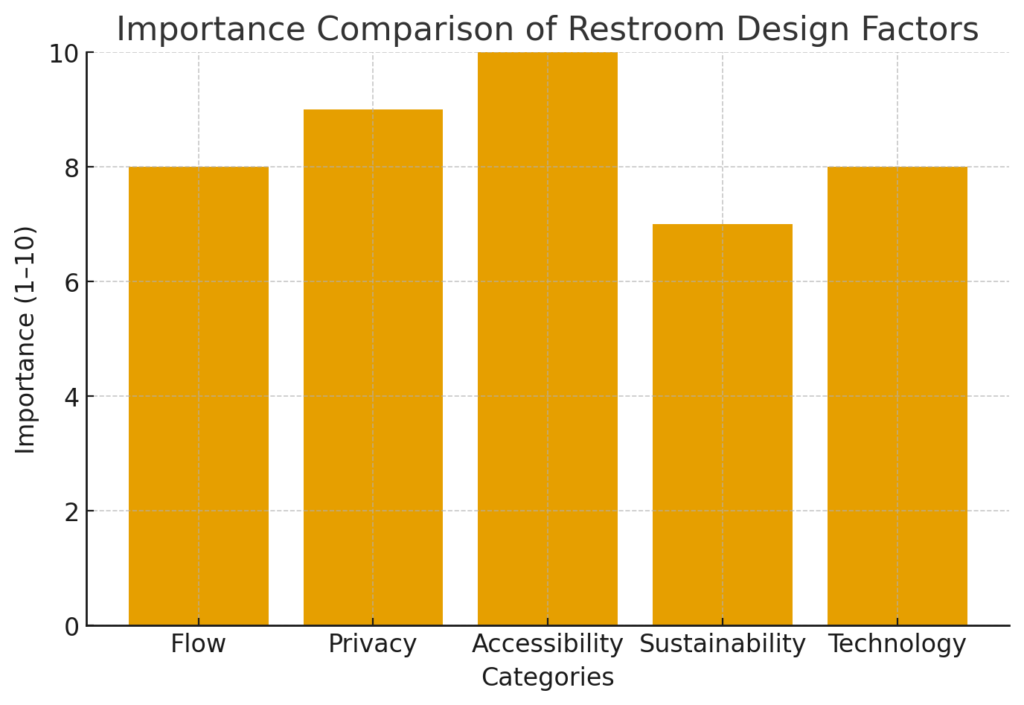
| Factor | Main Objective | Example Strategies |
|---|---|---|
| Flow | Smooth, intuitive movement with minimal congestion. | Doorless/maze-like entries, clear entry→wash→stall→exit path, adequate queuing space. |
| Privacy | Increase visual and acoustic comfort. | Full-height partitions, offset stalls, privacy screens, acoustic partitions and insulation. |
| Accessibility | Ensure all users can safely and independently use the restroom. | ADA-compliant clearances, reach ranges, accessible fixtures and routes. |
| Sustainability | Reduce water, energy use, and environmental impact. | WaterSense fixtures, efficient hand dryers, durable low-VOC and slip-resistant materials. |
| Technology | Use data and automation to improve performance over time. | Sensor-based faucets/flush valves, occupancy monitoring, predictive maintenance, BAS integration. |