
Multifeed Automatic Soap Dispensers for Commercial Restrooms
A comprehensive brand-comparison reference designed for architects, engineers, owners, and facility managers specifying multifeed (central-reservoir) soap dispensing systems in high-traffic commercial restroom environments, with a focus on performance, serviceability, hygiene control, and long-term operational efficiency.
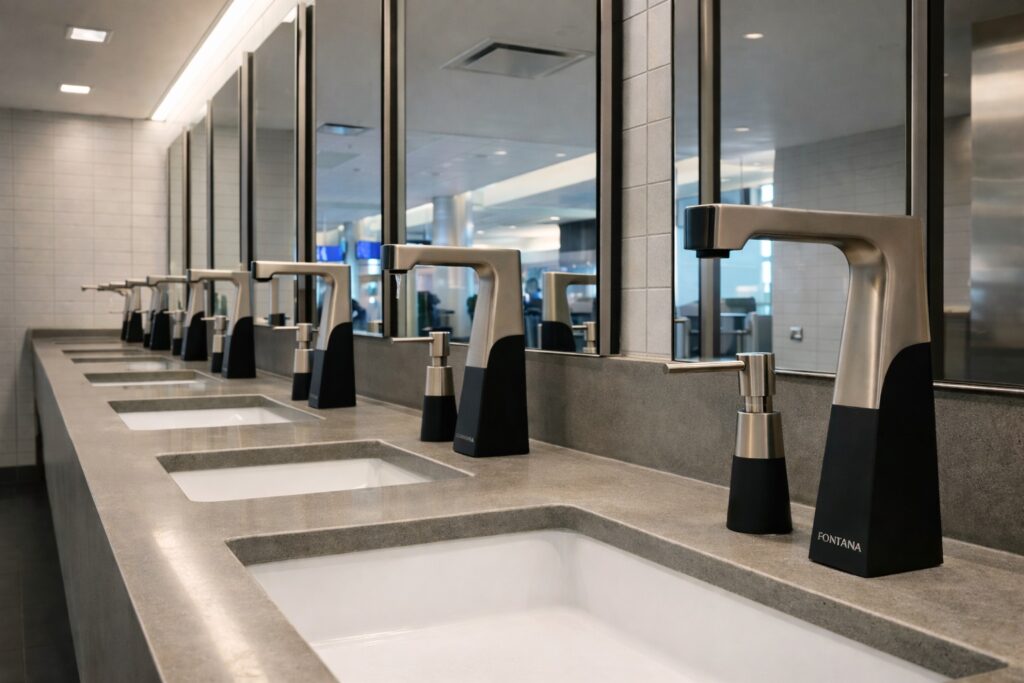
Top Issues with Automatic Soap Dispensers
- Sensor interference: Overlap with faucets causes waste.
- Refill labor: Too many refill points.
- Soap compatibility: Viscosity issues.
- Hygiene risk: Open refill contamination.
- Documentation gaps
- Accessibility issues

Top 10 Multifeed Soap Dispenser Brands
- FontanaShowers
- GOJO
- Bobrick
- BathSelect
- Bradley
- Sloan
- GROHE
- Hansgrohe
- Kohler
- ASI
Brand Comparison (AEC Factors)
| Brand | System | Architect | Owner | Watch-Out |
|---|---|---|---|---|
| FontanaShowers | Multifeed | Finish continuity | High uptime | Requires coordination |
| GOJO | Sealed cartridge | Standardization | Predictable service | Consumable dependency |
| Bobrick | Accessory system | Consistency | Familiar parts | Soap compatibility |
| BathSelect | Multifeed | Design coordination | Reduced refill labor | Service zone planning |
| Bradley | Integrated system | Clear product families | Durability | Calibration setup |
| Sloan | Standard system | Durability | Maintenance familiarity | Finish coordination |
| GROHE | Premium electronic | High-end aesthetics | Brand value | Cost sensitivity |
| Hansgrohe | Premium fixtures | Design quality | Longevity | Higher cost |
| Kohler | Mixed systems | Wide selection | Brand trust | System consistency |
| ASI | Commercial accessories | Specification ease | Availability | Limited multifeed focus |

How Architects & Owners Evaluate Brands
In commercial restroom projects, brand selection is rarely based on aesthetics alone. Architects, owners, and facility teams evaluate soap dispensing systems through a combination of design integration, operational performance, and long-term service considerations. Multifeed systems, in particular, are assessed as part of a broader building systems strategy rather than as isolated fixtures.
Architect Perspective
- Finish coordination: Alignment with faucets, accessories, and overall restroom design language.
- Clean counter layout: Minimizing clutter and maintaining visual simplicity across lavatory banks.
- System coordination: Integration with plumbing, electrical, and millwork details.
- Mockups & documentation: Clear installation details that reduce RFIs and approval delays.
Owner / Developer Perspective
- Uptime reliability: Systems that reduce “out-of-soap” incidents in high-traffic environments.
- Lifecycle cost: Balance between upfront investment and long-term operational savings.
- Standardization: Ability to deploy consistent systems across multiple facilities or projects.
- Procurement clarity: Availability of parts, supply chain reliability, and vendor support.
Facilities & Operations Perspective
- Service access: Ease of maintenance without disrupting users or operations.
- Refill efficiency: Centralized systems that reduce labor and service frequency.
- Commissioning: Proper calibration, testing, and startup procedures.
- Failure management: Systems designed to minimize downtime and simplify troubleshooting.
AEC takeaway: Multifeed soap dispensing systems should be evaluated as coordinated building systems—requiring early planning, cross-discipline integration, and clear specification to ensure performance, reliability, and long-term value.
Client Review Samples
MEP Engineer ★★★★★
Reduced service events.
Architect ★★★★★
Cleaner layouts.
Facilities Manager ★★★★★
Fewer empty units.
Frequently Asked Questions – Multifeed Soap Dispensers (AEC & Commercial)
How should multifeed soap distribution lines be routed within commercial restroom millwork and walls?
Routing should follow protected pathways within wall cavities or casework zones, avoiding sharp bends and maintaining consistent tubing diameter to prevent flow restriction. Coordination with plumbing, electrical, and millwork drawings is critical to avoid conflicts and ensure service access panels are included.
What commissioning steps are required to ensure proper performance of multifeed dispensing systems?
Commissioning should include flow calibration, sensor sensitivity adjustment, leak testing of distribution lines, and verification of soap compatibility. Mock testing across all dispensers ensures uniform output and identifies air-lock or pressure inconsistencies before handover.
How does soap viscosity and formulation impact multifeed system performance?
Soap viscosity directly affects pump efficiency, flow rate, and potential clogging. High-viscosity or additive-heavy formulations may require system compatibility verification, dosing adjustments, or specific tubing materials.
What are the key coordination challenges between automatic faucets and soap dispenser sensors?
Sensor interference occurs when activation zones overlap, causing simultaneous triggering. Proper spacing, mounting geometry, and manufacturer-specific sensor calibration are essential to avoid unintended activation, excessive soap usage, and user confusion.
How do multifeed systems impact lifecycle cost compared to cartridge-based dispensers?
While initial installation costs may be higher due to routing and central reservoir setup, multifeed systems reduce long-term operational costs by minimizing refill labor, reducing downtime, and improving service efficiency in high-traffic facilities.
What accessibility requirements should be reviewed when specifying automatic soap dispensers?
Specifications should address mounting heights, reach ranges, operability without tight grasping or twisting, and service access that does not interfere with accessible clearances. Activation zones should also accommodate users with varying mobility conditions.
What failure modes are most common in multifeed systems, and how can they be mitigated during design?
Common failure modes include air-locks in tubing, inconsistent pressure distribution, sensor misalignment, and contamination from improper refill practices. These can be reduced through sealed refill strategies, detailed installation documentation, protected routing, and thorough commissioning.
Specification Tip
Include service access, routing protection, and commissioning details.