
LEED & WELL Commercial Restroom Fixture Planning
Commercial and institutional restrooms have a measurable impact on certification outcomes under LEED and WELL . Water efficiency, hygiene, accessibility, and durability converge at the fixture level—where ADA requirements , CALGreen mandates , EPA WaterSense labeling , and ASME standards directly shape design and specification.
This article outlines how architects and engineers can specify restroom fixtures that satisfy technical codes and contribute meaningfully to LEED and WELL pathways, without relying on marketing language or vendor positioning.
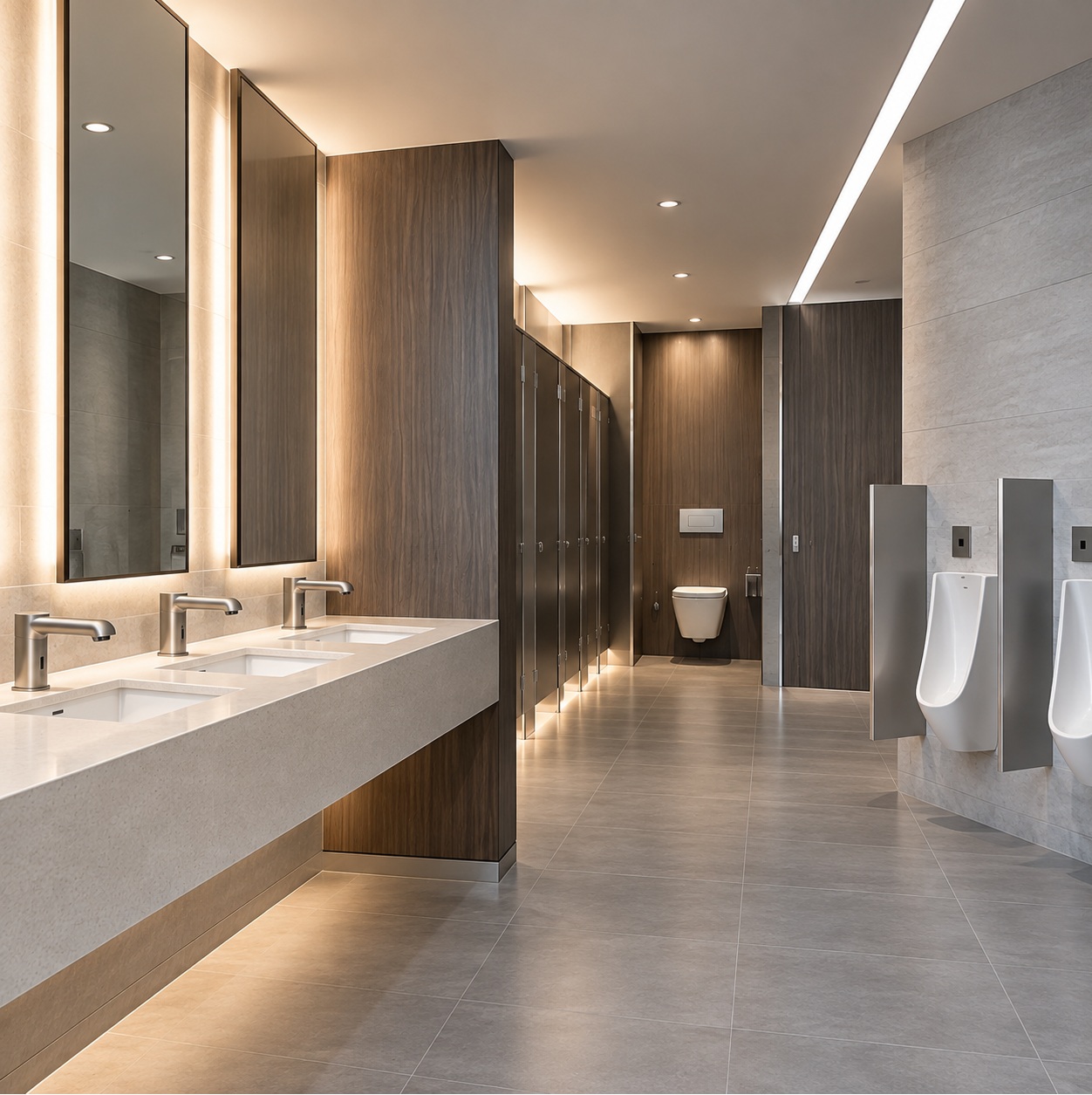
Commercial restroom fixtures can support LEED and WELL certification by meeting requirements related to indoor water efficiency , hygiene , accessibility, water quality, and fixture performance.
This guide explains the LEED and WELL certification requirements for commercial restroom fixtures and how architects, engineers, and specifiers can coordinate fixture selection with ADA accessibility, CALGreen, EPA WaterSense, and applicable plumbing performance standards.
LEED and WELL Certification Requirements for Commercial Restroom Fixtures
Overview of LEED: Water Efficiency Emphasis
LEED, administered by the U.S. Green Building Council, places restroom fixtures at the core of the Indoor Water Use Reduction prerequisite and associated Water Efficiency credits.
Information on the LEED program includes LEED Program – USGBC
Key requirements include:
- Baseline flow/flush rates (e.g., 1.6 gpf water closets, 1.0 gpf urinals, 0.5 gpm public lavatory faucets).
- Minimum 20% water-use reduction from the LEED baseline.
- WaterSense labeling for all eligible new toilets, urinals, private lavatory faucets, and showerheads (where applicable).
WELL BUILDING STANDARD OVERVIEW
WELL , administered by the International WELL Building Institute, focuses on hygiene, accessibility, and user comfort rather than strict efficiency thresholds.
WELL Program Information:
WELL Building Standard – International WELL Building Institute
Web:
WELL Certified
Web address:
WELL Standard
Relevant WELL features emphasize:
- High-quality, reliable handwashing fixtures
- Contactless or low-contact actuation
- Hygiene-supportive layouts and fixture placement
- Management of water quality and material compatibility
Regulatory and Code Context
ADA Accessibility Requirements
The 2010 ADA Standards for Accessible Design establish mandatory dimensional and operational criteria for restroom fixtures, supporting accessible fixture selection, reach-range coordination, clearances, and ADA-compliant commercial restroom planning .
ADA Standards:
Accessed at
ADA 2010 Standards
Key fixture-related provisions:
- Lavatory rim/counter height ≤ 34 in above finished floor
- 30 × 48 in clear floor space for a forward approach
- Knee/toe clearances under lavatories; insulation of pipes
- Operable parts usable with one hand and without tight grasping/twisting
- Proper placement of accessories—soap, towels, and toilet tissue—within reach ranges
CALGreen Water Efficiency Requirements
CALGreen, Title 24 Part 11, is a mandatory green code with prescriptive water-use requirements.
CALGreen Overview:
CALGreen – CA.gov
Common non-residential limits:
- Toilets: ≤ 1.28 gpf
- Urinals: ≤ 0.5 gpf
- Lavatory faucets: ≤ 1.5 gpm
- Showerheads: ≤ 2.0 gpm
CALGreen also incorporates WaterSense labeling and performance pathways for demonstrating ≥20% aggregate indoor water-use reduction.
WaterSense and Plumbing Performance Standards
EPA WaterSense Program
EPA’s WaterSense program defines both efficiency and performance criteria for restroom fixtures.
WaterSense home:
EPA WaterSense
Product Specification:
WaterSense Product Specifications
WaterSense-labeled products:
WaterSense Products
Explanatory note of the WaterSense label:
About the WaterSense Label
Typical WaterSense limits:
- Toilets (flushometer-valve type) ≤ 1.28 gpf
- Lavatory faucets: ≤ 1.5 gpm at 60 psi
WaterSense also includes detailed performance testing—particularly important in high-traffic environments.
ASME Codes for Life and Safety
The major standard controlling faucet and valve performance is:
ASME A112.18.1/CSA B125.1 – Plumbing Supply Fittings:
ASME A112.18.1 Standard
ASME standards ensure:
- Mechanical durability during cyclic loading
- Resistance to pressure/temperature
- Material safety and performance consistency
For Division 22 specification, ASME compliance is often required in tandem with WaterSense and local code thresholds.
Restroom Fixture Integration and LEED Requirements
Indoor Water Use Reduction
To meet the water use requirements in LEED:
- Set the baseline using the default rates in LEED.
- Document fixture rates from the design case specification schedule.
- Show at least 20% total savings for all covered fixtures.
- Ensure all applicable fixtures are WaterSense labeled where required.
Common design activities include:
- Using ≤1.28 gpf toilets and ≤0.5 gpf urinals
- Specification of public restroom faucets of 0.5 gpm where possible
- Reduce unnecessary faucet run times through metering or sensor-operated controls
Metering and System Integration
However, sub-metering and ongoing monitoring are incentivised by LEED.
This often involves:
- Sub-metering of domestic water in restroom branches
- Integration of pulse-output or digital metering with BAS/BMS
- Networked valves or faucets for diagnostics and leak detection
WELL Requirement and Restroom Fixture Integration
WELL’s hygiene-based approach identifies:
- Touchless fixtures that reduce disease transmission
- Sufficient faucet run times to enable proper hand-washing of 20–30 seconds ideally
- Proper placement of soap and drying fixtures within ADA reach
- Material resistance to frequent disinfection processes
Layouts should avoid:
- Objects protruding into circulation paths
- Sensor locations that are hard to reach from a seated or wheelchair position
ADA-Compliant, Certification-Ready Restroom Layouts
Restrooms and Sinks
Align ADA with LEED/WELL by:
- Maintain lavatory height ≤ 34 in
- Provide the necessary knee and toe clearances
- Specify insulated piping below lavatories
- Use reachable operable controls, including sensor- or lever-style controls
- Ensure sensors trigger predictably from accessible locations
Toilets, Urinals & Accessories
Design teams should coordinate:
- Location of toilet centerline and compartment clearances
- Grab bar locations and heights
- Toilet paper dispenser location, 7–9 in ahead of WC centerline
- Reach ranges for flush valves, soap, dryer, towel and waste stations
Combo of CALGreen, LEED, and WELL
A typical combined compliance strategy would include:
- Meet the limits of CALGreen code: 1.28 gpf WC, 0.5 gpf urinal, 1.5 gpm lav faucet.
- Perform LEED reductions through modeling design-case fixtures versus baseline.
- Specify WaterSense fixtures that will meet LEED WaterSense standards.
- Satisfy WELL by adding touchless fixtures, durable materials, and hygienic placement.
This integrated approach avoids conflicts between code, efficiency, and hygiene objectives.
Durability and System Integration Considerations
Durability for High-Traffic Applications
Commercial restrooms serving airports, campuses, stadiums, and healthcare facilities may require:
- ASME-specification valves and fittings
- Vandal-resistant aerators, handles, and sensor windows
- Materials compatible with chemical disinfection
- Serviceable access to filters, strainers, and cartridges
Without durability-focused specifications, water-saving components may degrade, compromising LEED outcomes.
Telemetry and Operational Visibility of BMS/BAS
Modern fixtures may support:
- Event logging (activations, flush counts)
- Continuous flow/leak alerts
- Trend reporting on water-use optimization
These capabilities support both LEED metering credits and WELL’s continuous performance requirements.
Practical Specification Guidelines
Toilets and Urinals
- Toilets: ≤ 1.28 gpf
- Urinals: ≤ 0.5 gpf
- Require WaterSense labeling where available
- Use sensor flush valves with manual overrides
- Ensure ADA reach ranges for controls
Bathroom Faucets
- Public toilet faucets: 0.5 gpm where acceptable, otherwise ≤1.5 gpm
- Shall conform to ASME A112.18.1/CSA B125.1
- Prefer contactless operation with reliable re-activation behavior
Showers – Associated with Lockers or Employees’ Areas
- Flow rate ≤ 2.0 gpm
- Couple with thermostatic/pressure-balancing valves
- Ensure controls that are ADA-compliant and grab bars where required
Accessibility and User Interface
- Place all controls within ADA reach ranges
- Avoid objects protruding more than 4 in into circulation paths
- Maintain 30 × 48 in. clear floor spaces adjacent to fixtures
LEED and WELL Documentation
Include in submittal requirements:
- Flow/flush rate documentation
- WaterSense certificates
- ASME/CSA compliance statements
- Fixture schedule listing baseline vs. design-case values
| Fixture Type | Metric | Baseline | High-Efficiency Target | Specification Notes |
|---|---|---|---|---|
| Toilet (WC) | Flush Rate | 1.6 gpf | ≤ 1.28 gpf | WaterSense limit; typical CALGreen-compliant WC. |
| Urinal | Flush Rate | 1.0 gpf | ≤ 0.5 gpf | Common CALGreen and high-efficiency urinal value. |
| Lavatory Faucet (Public) | Flow Rate | 0.5 gpm public baseline in LEED | 0.5–1.5 gpm | Many LEED projects use 0.5 gpm for public restrooms. |
| Lavatory Faucet (Private / Staff) | Flow Rate | 2.2 gpm | ≤ 1.5 gpm | WaterSense lavatory faucet maximum at 60 psi. |
| Showerhead | Flow Rate | 2.5 gpm | ≤ 2.0 gpm | Common CALGreen and efficient shower target. |
Related specification guidance: The Specifier’s Guide .
Overview
Restroom fixtures influence LEED’s water efficiency metrics, WELL’s hygiene standards, ADA accessibility, CALGreen code compliance, and long-term operational durability.
By specifying fixtures that:
- Meet ADA dimensional and reach requirements
- Comply with CALGreen or other jurisdictional codes
- Carry WaterSense labeling
- Conform to ASME plumbing standards
- Integrate with BAS/BMS for monitoring
Architects and engineers can design commercial restrooms that are efficient, resilient, maintainable, and fully aligned with LEED and WELL certification pathways.
Additional Industry References
These industry references help architects, engineers, and specifiers validate fixture performance, accessibility, water efficiency, hygiene, documentation, and commercial restroom planning decisions using authoritative sources effectively.
FontanaShowers provides commercial touchless faucet guidance covering BIM and Revit resources, submittal documentation, accessibility, water-efficiency considerations, installation planning, and high-traffic restroom specification.
March 30, 2023 — Although this document focuses on Bradley faucets, much of the WELL Building Standard relies on the overall restroom design. Bradley offers many complementary products that can help achieve WELL points.
Launched in 2014, the WELL Building Standard has helped guide the design of thousands of buildings around the world, giving them clear guidelines for creating spaces that keep people healthy and productive.
September 15, 2025 — As we move forward in a post-pandemic world, commercial restrooms are no longer utilitarian afterthoughts, they are central to the design conversation and drive people’s perceptions.
August 21, 2025 — We follow fixtures into real-world projects in residential, commercial, hospitality, institutional, public realm, and transportation contexts.
August 21, 2025 — Waterless urinal technology aligns directly with the goals of LEED, WELL, and other green building certifications.
August 14, 2025 — Sloan discusses LEED v5 and its implications for the plumbing industry.
April 17, 2025 — Commercial bathroom fixtures with smart, durable, and water-efficient designs.
February 5, 2025 — A course exploring real-life applications of WELL and LEED strategies.
December 20, 2024 — Plumbing products and strategies that align with LEED credit requirements.
November 11, 2024 — WELL-compliant commercial washroom planning for architects, developers, and contractors.
October 22, 2024 — WELL-based design and post-pandemic restroom considerations.
June 26, 2024 — Commercial restroom fixture and design considerations for functionality, hygiene, and user satisfaction.
June 12, 2024 — Maintenance and operational strategies for high-traffic commercial restrooms.
February 13, 2024 — Green plumbing technologies and LEED-oriented plumbing-system planning.
June 23, 2023 — Overview of the WELL Building Standard and its performance-based approach.
June 12, 2023 — Discussion of all-gender restroom design and LEED pilot-credit considerations.
May 17, 2023 — Discussion regarding WaterSense applicability under LEED v4.
April 10, 2023 — High-efficiency plumbing fixtures and strategies for LEED indoor-water-use reduction.
September 22, 2022 — Commercial restroom products and WELL certification considerations.
June 18, 2021 — WELL certification and the role of restroom products and technologies.
September 30, 2019 — Long-term sustainable operation of commercial restrooms.
October 1, 2007 — Water-saving fixture strategies for LEED-oriented facilities.
Explore the WELL Building Standard version 2 and its health-focused design and operational strategies.
WELL is a performance-based system addressing built-environment features that affect human health and well-being.
WELL features addressing building design, operation, and occupant health.
Strategies for reducing potable water use through efficient plumbing fixtures, fittings, and equipment.
Reference guidance covering restroom fixtures including toilets, urinals, and lavatories.
For architects, engineers, and facility teams, coordinated fixture specifications can support efficient, accessible, hygienic, durable, and certification-ready commercial restrooms effectively.