
Commercial restroom design, it could be said, is one of the highest indicators of a building as a whole and its regard for its users. From airplanes to schools, restaurants to corporate workplaces, commercial restrooms are so much more than practical. They represent the ideals of accessibility, cleanliness, sustainability, and corporate brand all in a few square meters. The best modern commercial bathrooms strike the right balance of technological exactness and design appeal, combining compliance and beauty with comfort and efficiency.
Accessibility: Designing for All
Accessibility is not optional—it’s mandatory. A quality, accessible restroom gives all users, regardless of physical ability, the ability to access the facilities safely and independently. ADA remains the benchmark, but visionary architects and designers are reaching beyond minimum code to designing truly barrier-free environments.
Design considerations include ample room to maneuver a wheelchair, grab bars installed with ergonomic accuracy, and touch-operated controls that reduce demands on fine motor skills. Stall length, door width, and counter height are all to be remembered as they make a contribution to usability. Self-opening doors, adjustable mirrors, and equipment sited lower down are now expected by specifiers—use features for people with disabilities but added convenience for children, older people, and others who travel with bags or luggage.
The best projects also take into account neurodiversity and sensory access, avoiding very harsh lighting or very obnoxious, aggressive hand dryers that are overwhelming to certain customers. It is more than a question of greeting but greeting.
Hygiene and Touchless Technology
The past decade has witnessed a revolution in the way public and commercial toilets handle hygiene. Touchless operation—from faucets and soap dispensers to flush valves and hand dryers—has gone from being a luxury to an expectation. These systems provide enhanced sanitizing, less water consumption, and enhanced overall user satisfaction.
New corporate bathrooms utilize smart sensors that control flow rates while in use and monitor soap or paper levels remotely through a Building Management System (BMS). Designers are also placing strong focus on easy-to-clean materials, such as solid-surface countertops and bacteria-resistant, stain-inhibiting wall cladding.
Following the pandemic, public health has been reinforced as a part of design integrity. Sanitizing isn’t an afterthought anymore now—thin-line sensor faucets, concealed pipes, and sleek countertops balance hygiene and modernity.
Maintenance Efficiency and Longevity
Heavy-use facilities need materials and designs that have already withstood heavy use. While the bathrooms in a residential dwelling can all be about looks, commercial bathrooms need to endure hundreds or thousands of customers on a daily basis. In a situation like this, durability speaks volumes as a design language.
The designers opt for vandal-resistant hardware, phenolic partitions, and stainless steel hardware that resists wear without compromising a modern look. Maintenance efficiency—how quickly a building can be swept, repaired, or resupplied—is just as vital. Less floor space taken up by wall-hung toilets and sinks allows for quicker cleaning, and access panels in back-of-house spaces allow service techs to fix plumbing without startling users.
By combining material selection and maintenance practices, designers extend the lifespan of the restroom, minimize downtime and operational costs.
Sustainability and Water Stewardship
Sustainability is no longer a marketing nicety—it’s an ethics issue. Water conservation is the prime path to sustainable restroom design. Low-flow, high-efficiency fixtures, sensor-operated devices, and greywater recycling systems are modern-day water-waste conservation standards.
Beyond plumbing, sustainability can be brought to bear in energy-efficient lighting, recycled content, and indoor air quality management. LEED or WELL Building certification is what most facilities pursue, and toilet room design supports furthering environmental performance. Ventilation and humidity control limit mold growth and extend fixture life.
Of equal importance is specifying green-certified finishes—low-VOC paint, sustainably sourced tile, and recycled-aggregate countertops—all of which enhance indoor health.
Flow, Privacy, and Layout
Good bathroom design is an amalgam of half movement and half material. Expertly designed layouts allow for fluid flow, privacy, and safety. Entrances need to have views into the private area without depriving access. Door-free entrance corridors are the architects’ choice these days since they ensure easier access and less contact.
Privacy is still important in customer satisfaction. Full height-running stalls, acoustic partitioning, and partition positioning all contribute to the provision of a comfort and dignity environment. Lighting design is also important—utilizing indirect lighting in the avoidance of glare as well as the creation of the illusion of security and hygiene.
Family and unisex restrooms are another new norm. These are facilities that contribute to added convenience and flexibility and the easy maintenance logistics.
Aesthetics and Brand Expression
Companies’ bathrooms are the hallmark of brand image. The luxury hotel will have soft ambient lighting and natural stone, but a technology campus can be bare concrete with matte black fixtures. These design aesthetics speak to the company’s culture and values.
Designers today treat these areas as micro-spaces within the broader building story. Finish palettes, materiality, and lighting can reclaim the brand color scheme or architectural language used elsewhere. Even the smallest luxuries—such as a logo-engraved mirror or specialty finish on hardware—can turn an effective space into a branded space.
The aesthetic layer doesn’t deal with look; it deals with feelings. When people experience something amazing, they relate that to the institution or company right away.
The Marriage of Design and Technology
Data-driven instinct is the foundation of the future of business bathroom design. Sensors already report in real-time on usage to building managers, allowing for predictive cleaning schedules and reducing wastage. IoT platform interfaces enable maintenance personnel to monitor performance, detect leaks, and report on resource use in real time.
Water- and energy-saving smart bathrooms also offer a glimpse into real use of spaces—fading future design in a reality check based on hard fact. Technology is redefining bathrooms in a variety of different forms to create them living systems that can learn, adapt, and evolve.
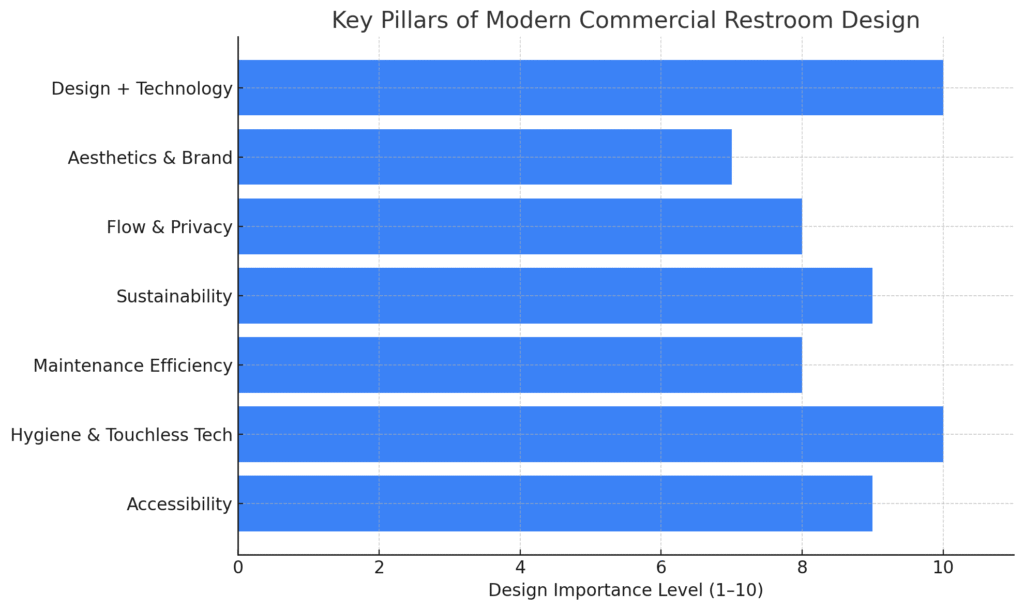
Conclusion: Designing Beyond Function
From functionality to aesthetics, corporate bathroom design is no longer a multidisciplinary art that takes elements of architecture, engineering, technology, and human intuition. The ideal rooms are sanitary, accessible, durable, and beautiful—reaching the equilibrium of utilitarian functions and human health.
Finally, the bathroom is not an afterthought; it is a tell-and-show of how much an organization cares about comfort, fairness, and sustainability. In every way—to where a grab bar will be installed to the glint on a faucet—designers design spaces that leave a lasting impression long after the user leaves the room.
| Pillar | Focus | Key Impact |
|---|---|---|
| Accessibility | Inclusive, ADA-compliant layouts | Equal access and comfort for all users |
| Hygiene & Touchless Tech | Sensor-based, contact-free systems | Improved sanitation and water efficiency |
| Maintenance & Longevity | Durable, easy-to-service materials | Lower costs and longer lifespan |
| Sustainability | Water- and energy-efficient design | Reduced environmental footprint |
| Flow & Privacy | Smart layouts, acoustic partitions | Comfort and ease of movement |
| Aesthetics & Brand | Design aligned with brand identity | Stronger brand perception |
| Design + Technology | IoT and smart monitoring | Predictive maintenance and efficiency |